
Landscape Lighting Designers Guide To Specifying the Right Product
Landscape Lighting Guide
One of the biggest mistakes I see in landscape lighting is treating every project—and every application—as if it requires the same fixture.
For some landscape contractors, or even landscape lighting contractors who rely heavily on one product line, the approach can become a version of the old saying: if all you have is a hammer, everything starts to look like a nail.
They find an uplight they like, a path light they like, and a transformer they are comfortable with, and those products end up getting specified on nearly every project regardless of the architecture, landscape, scale, finish, or intended lighting effect.
An experienced landscape lighting designer approaches product specification very differently.
The fixture should be selected because it is the right tool for that specific application, not simply because it is the fixture you normally install.
There are a number of factors that should influence that decision.
Start With the Required Light Output
Before selecting a fixture, you first need to understand what you are actually trying to illuminate.
A small dwarf palm does not require the same lumen output as a mature royal palm.
A young ornamental tree does not require the same fixture as a large canopy tree with a 30- or 40-foot spread.
The scale of the landscape material should dictate the amount of light required.
When illuminating larger palms, canopy trees, architectural elevations, or other substantial features, the fixture needs enough lumen output and optical control to carry light through the entire subject.
On smaller plant material, excessive output can create the opposite problem. Instead of creating a subtle, elegant effect, the landscape becomes overlit and visually flat.
This is why specifying solely by fixture type is not enough.
Two fixtures may both technically be “uplights,” but they may have dramatically different lumen packages, beam spreads, optics, lamp positions, and photometric performance.
A designer should be thinking about questions such as:
- How tall is the subject?
- How wide is the canopy?
- How far will the fixture be positioned from it?
- How much ambient light already exists in the area?
- Do I need a narrow beam with longer throw, or a wider beam with softer distribution?
- Am I trying to highlight the trunk, illuminate the canopy, or accomplish both?
The fixture specification comes after understanding the desired lighting effect.
Color Temperature Should Relate to the Entire Property
Kelvin temperature is another area where landscape lighting should never be designed in isolation.
Before specifying the exterior landscape lighting, I want to understand what other sources of light are already present throughout the property.
What Kelvin temperature are the architectural sconces?
What about recessed lighting under the soffits?
Are there pendants at the entry?
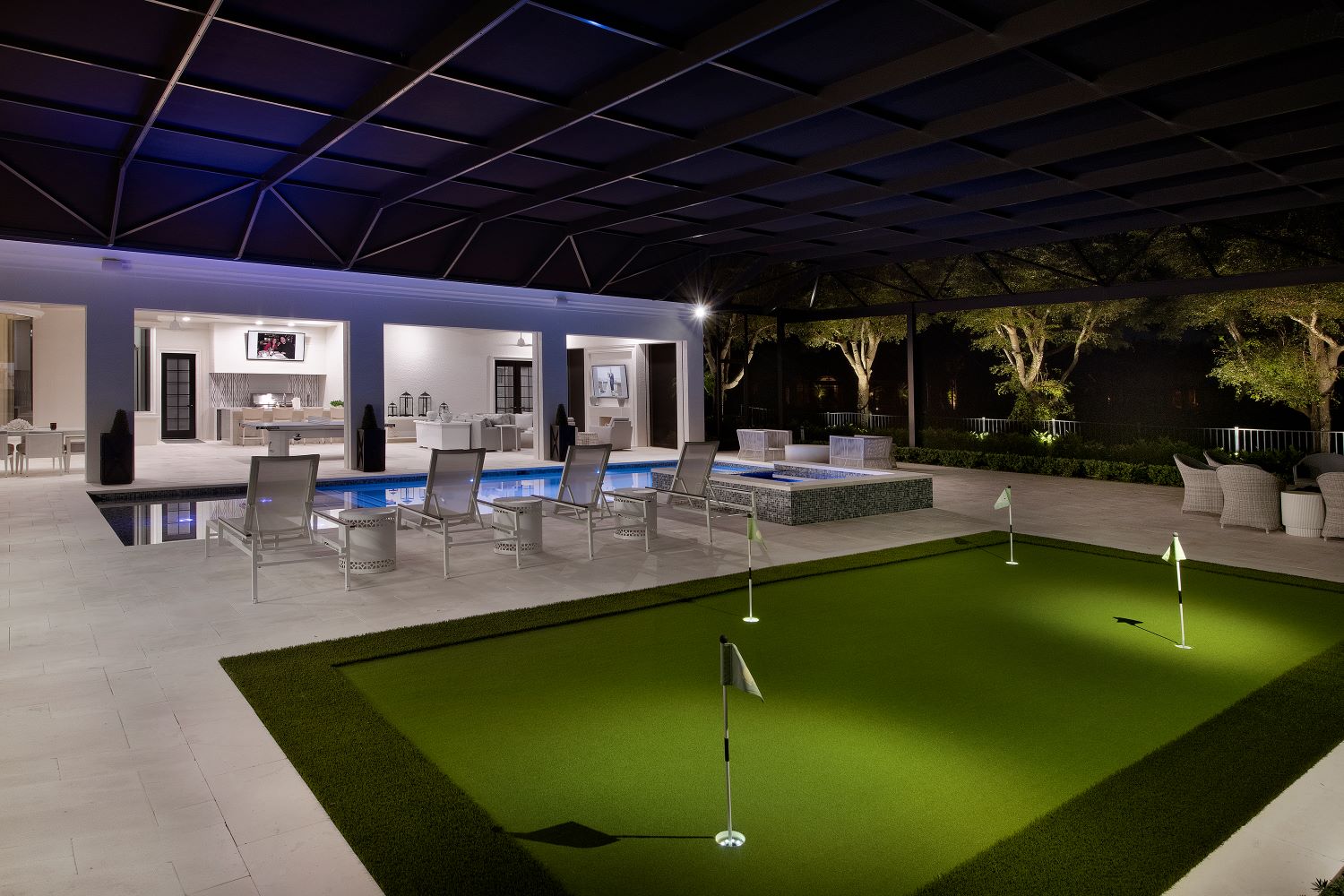
Is there lighting around an outdoor kitchen, pool, pergola, or lanai?
If the architecture is predominantly illuminated at 2700K and the landscape lighting is suddenly installed at 3000K or 4000K, the difference can become immediately noticeable.
Neither color temperature is necessarily wrong on its own. The problem is that the property can begin to feel disconnected.
Good lighting design should feel intentional.
The landscape lighting, architectural lighting, and decorative lighting should work together as one composition rather than appearing as separate systems that were designed by three different people at three different times.
There are certainly occasions when varying color temperatures intentionally can add depth or hierarchy. But that should be a deliberate design decision—not something that happened because a contractor happened to have a certain lamp on the truck.
Fixture Finish Matters More Than Many Designers Realize
The daytime appearance of landscape lighting matters too.
When I walk a property, I pay close attention to the finishes that have already been established by the architect and interior or exterior designer.
Are the exterior sconces copper?
Aged brass?
Black?
Bronze?
Stainless steel?
What finishes are used on the doors, windows, gutters, railings, hardware, and other architectural elements?
If a home has beautiful copper architectural sconces, incorporating copper landscape lighting fixtures can help continue that material palette throughout the exterior.
The result feels harmonious.
Conversely, installing an unrelated fixture finish can make the landscape lighting feel like an afterthought.
The same principle applies to contemporary architecture.
If a modern home utilizes clean black architectural fixtures, a modern black bollard-style path light may make far more sense than a traditional mushroom-style path light.
The fixture itself becomes part of the design language of the property.
That is an important distinction.
A landscape lighting fixture is not only something that produces light at night. In many locations, it is also a visible architectural object during the day.
Path Lights Should Complement the Architecture
Path lighting is one of the easiest places to see the difference between simply installing lights and actually designing a lighting system.
There are hundreds of path-light styles available.
Traditional hats, minimalist stems, architectural bollards, contemporary linear fixtures, decorative brass fixtures, copper fixtures, shielded fixtures—the list goes on.
The decision should not simply be, “This is the path light we normally use.”
Instead, look at the home.
A traditional Mediterranean residence may call for something completely different from a modern coastal home.
A contemporary property with black-framed windows and modern black sconces may benefit from a very understated black architectural bollard.
A home with natural copper gutters and copper lanterns may look dramatically better with an aged copper or natural copper fixture.
When everything relates back to the architecture, even subtly, the overall property feels more thoughtfully designed.
CRI Is About More Than a Number
CRI—Color Rendering Index—is another specification we pay very close attention to.
At the simplest level, CRI measures how accurately a light source renders colors compared with a reference light source.
But simply saying that a lamp has a CRI of 90 or 95 does not tell the entire story.
Different LEDs can render individual colors differently.
A light source may perform extremely well overall while performing less effectively on certain portions of the color spectrum.
This becomes particularly important when illuminating architectural materials.
For example, imagine a home with a reddish brick veneer.
Two different 2700K LED lamps may appear relatively similar when looking directly at the lamps themselves, but the brick can look noticeably different once illuminated.
One lamp may render those reds much more naturally and richly than the other.
That is why, on higher-end projects, it can be worthwhile to look beyond the general CRI number and consider the individual color-rendering values of the lamp.
The same thinking applies to other materials.
Warm woods, terracotta, red brick, green landscaping, natural stone, painted stucco, and architectural metals can all respond differently depending on the spectral characteristics of the LED being used.
Our goal is always for the lighting to reveal the true character of the material rather than distort it.
Beam Spread Is Just as Important as Lumen Output
More lumens do not automatically mean better lighting.
Optics matter.
A narrow-beam fixture can carry light significantly farther than a wide flood using a similar amount of output.
If I am illuminating a tall, narrow royal palm, I may want a relatively controlled beam that carries light vertically.
If I am illuminating a broad canopy oak, I may need a wider distribution—or multiple fixtures positioned from different angles—to create depth throughout the canopy.
On architecture, beam spread becomes equally important.
A narrow beam may beautifully accentuate a vertical architectural feature, while the same beam could create an undesirable hot spot on a wide wall.
The designer needs to think about where the light is going, not simply how much light the fixture produces.
Glare Control Should Influence Fixture Selection
A technically impressive fixture is useless if the customer sees a bright LED every time they walk through the property.
One of the hallmarks of good landscape lighting is that you notice the effect before you notice the source.
Fixture location, shielding, glare guards, louvers, aiming ability, and optical control should all factor into product selection.
A fixture located beside a driveway may need significantly better glare control than the same fixture positioned deep within a landscape bed.
A path light beside an outdoor seating area may require a very different shield or fixture design than one located along a secondary garden path.
The viewing angles matter.
That is why product specification cannot be separated from the actual site conditions.
Environmental Conditions Matter
The environment should also influence what materials and products are specified.
Coastal properties are a perfect example.
Salt air, irrigation overspray, fertilizer, humidity, and constant exposure to the elements can be extremely demanding on outdoor fixtures.
Material selection matters.
Brass, copper, and marine-grade stainless steel can perform very differently than lower-grade painted or powder-coated metals in harsh environments.
Even within the same project, different fixture materials may make sense in different locations.
A fixture located immediately adjacent to a pool, directly exposed to irrigation, or near saltwater may require greater corrosion resistance than a fixture protected beneath an architectural overhang.
The best fixture is not simply the fixture that looks good on the specification sheet. It needs to survive where you are putting it.
Serviceability Should Be Part of the Design
Another frequently overlooked part of product specification is long-term serviceability.
Landscape lighting systems live outdoors.
Plants grow.
Landscapes change.
Irrigation systems move.
Fixtures get bumped.
LED components eventually fail.
A beautiful system that becomes difficult or extraordinarily expensive to service five years later was not necessarily well designed.
Whenever possible, we consider whether lamps, drivers, lenses, optics, seals, and other components can be serviced or replaced.
We also look at manufacturer support and product continuity.
For a luxury residence expected to remain in place for decades, those considerations matter.
There Is No Single “Best” Landscape Lighting Fixture
This is ultimately the most important lesson.
There is no universally best uplight.
There is no universally best path light.
There is no universally best landscape lighting manufacturer.
There is only the product that best accomplishes the particular design objective in front of you.
One project may require a high-output fixture with a very narrow optic to reach the canopy of a mature palm.
Another may require an extremely soft, low-output fixture to illuminate a small ornamental tree.
A copper fixture may be ideal on one residence while looking completely out of place on the contemporary property next door.
A particular LED may render the stone beautifully on one home while another lamp performs better against brick.
The more experienced you become as a landscape lighting designer, the less likely you are to approach every project with the same handful of products.
Instead, you begin building a toolbox.
Different outputs.
Different optics.
Different color temperatures.
Different spectral characteristics.
Different materials.
Different finishes.
Different mounting methods.
Different glare-control options.
And then you select from that toolbox based on what the architecture, landscape, environment, and desired nighttime experience actually require.
That is the difference between installing landscape lights and designing landscape lighting.
The fixture should never dictate the design.
The design should dictate the fixture.